
LaGrange County Tax Record Coverage
Coverage splits across several linked systems. Beacon's parcel report carries the property number, land and improvement assessments, taxing district, school corporation, and displayed deductions. The Auditor Tax List works as a quick locator. PayGov serves as the county-linked real-estate tax search and payment gateway. The treasurer handles official balances and receipts.
| Tax field | Meaning in the record | Primary source |
|---|---|---|
| Land and improvement assessments | Separate components that form the total assessed value | Assessor and Beacon parcel report |
| Deductions and exemptions | Displayed relief that can change taxable value | Auditor records; Beacon gives a useful clue |
| Tax district and school corporation | The local units tied to the parcel | Beacon and Auditor Tax List |
| Bill, installments, and balance | Charges, due amounts, and payment information | Treasurer and PayGov |
| Delinquency or sale status | A dated lead that needs current confirmation | Treasurer and GUTS status lists |
A tax amount is not a sale price. It reflects assessment, deductions, rates, credits or caps, special assessments, and payment history. A parcel report helps assemble those pieces. The official bill controls precise dollar claims. Readers focused on the meaning of the assessment rather than the bill can turn to the LaGrange County property value explanation.
PayGov Tax Search Fields
The county-linked PayGov real-estate tax search accepts any of three inputs. An address needs three or more characters. Broad results cap at the first 1,000 records, which is why a parcel number is usually the sharpest key.
| Search control | How it works | Use with care |
|---|---|---|
| Location Street Address | Text field, optional, minimum three characters | Preserve direction and road name |
| Name | Optional taxpayer-name field | A name may return more than one parcel |
| Parcel Number | Optional parcel-key field | Keep punctuation and any alternate number |
The form finds an account first. Payment details appear only after a parcel is chosen, so the search screen alone proves nothing about later bill fields.
LaGrange Auditor Tax List
The county's Auditor Tax List lets you search by district, parcel number, owner name, tax year, or property address, and each result row repeats the district, parcel, name, and address. The list runs to 32,742 entries. It labels itself “Not for Official Use!” Treat it as a locator, not an official statement of what is owed.
The search screen offers a useful local tip. When land was split or combined within the past two years, a last-name search will surface every related bill. Copy each parcel string exactly as shown. Some rows carry both a hyphenated identifier and a second numeric code. The interface does not define that second number, so do not label it a deed or replacement parcel without confirmation.
Index first. Pair an Auditor Tax List result with PayGov and direct Treasurer confirmation before stating that a bill is paid or delinquent.
Trace a LaGrange County Tax Bill
A sound property tax search moves from identification to confirmation. Keep the tax years separate, and save screen dates because names, balances, and sale statuses can change.
- Find the property in Beacon and copy its full parcel number, brief legal description, tax district, and assessment.
- Search PayGov by parcel number, then compare the name and address with the same parcel.
- Use the Auditor Tax List to check the chosen tax year and identify split or combined parcel clues.
- Review displayed deductions, then contact the Auditor if the underlying application or approval matters.
- Ask the Treasurer for the official bill, receipt, payment history, or current delinquency status.
- Assessed value
- The assessor's value assigned under Indiana's market value-in-use system.
- Levy or tax rate
- The government charge applied within the parcel's taxing units; it is distinct from the parcel's value.
- Homestead deduction
- One form of tax relief administered through the Auditor, subject to its own application and approval record.
- Tax lien
- A legal claim tied to unpaid property tax; a search result does not show that it has been released.
LaGrange County PayGov Screen
This PayGov search entry opens the county tax gateway.
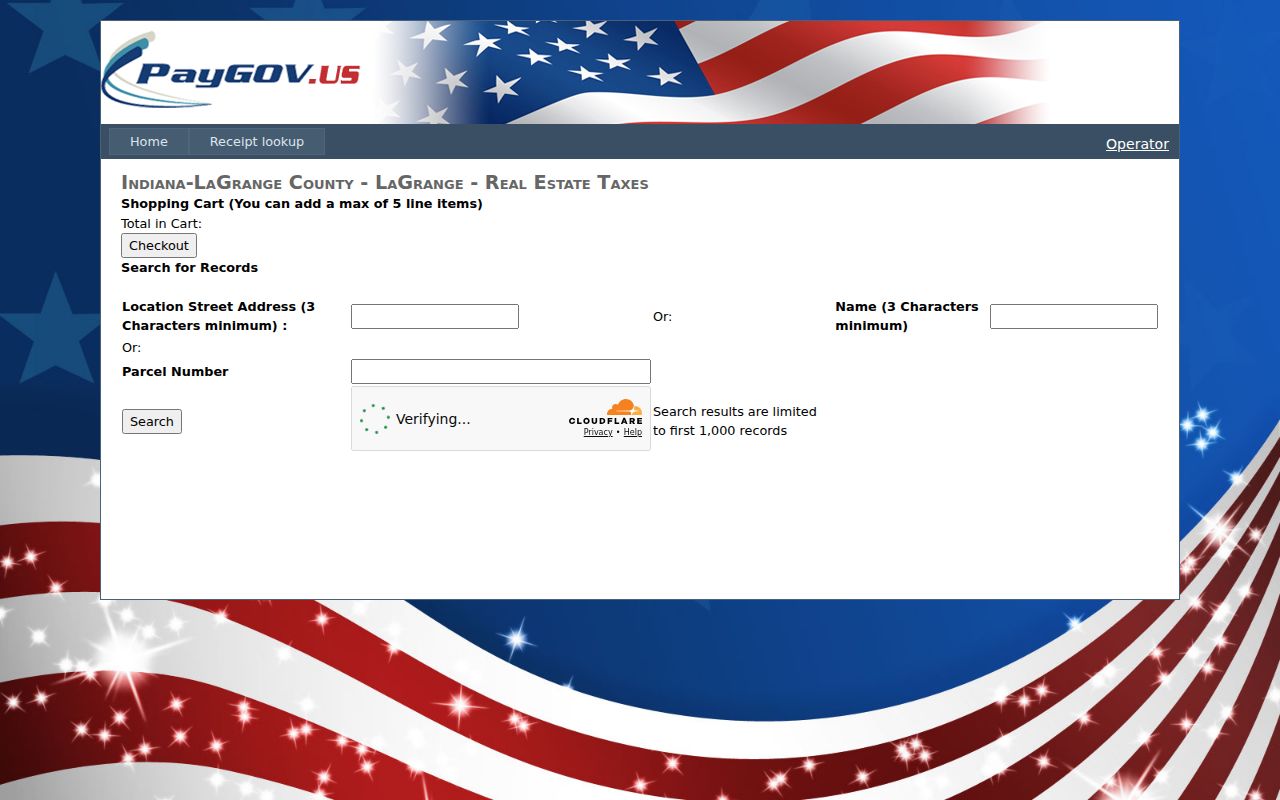
Use the image to spot the right starting form. A selected account plus a dated Treasurer response is still needed before any current payment conclusion.
LaGrange County Tax Deductions
The county contact sheet lists deduction questions for the Auditor. These cover homestead, mortgage, veteran, veteran-and-age, age-65, geothermal, and disability deductions. Assessed-value questions go to the Assessor. Drainage goes to the Surveyor. These handoffs keep one displayed figure from standing in for the whole tax file.
A Beacon deduction line is a clue. Preserve the tax year, application, approval or denial, and amount. A deduction decision can shift taxable value. This holds true even when the land and building assessment stays flat.
2026 LaGrange Assessment Cycle
Indiana's statewide cyclical reassessment begins July 1, 2026. It covers the 2026 pay-2027 cycle. DLGF says about one quarter of parcels get physically inspected each year across four years. Inspectors may verify garages, pools, and square footage.
A value change can also come from annual trending. It can come from a corrected feature, an omitted improvement, or a deduction change. The visit month for a specific LaGrange County parcel is not announced. Keep the dated property card and Form 11 notice. The record then shows what changed and when.
LaGrange Delinquency Status Records
The Treasurer and GUTS identify a September 15, 2026 tax sale. Separate lists cover advertising, bidders, county liens, sold items, and status. Each list marks a different stage. An advertising list shows what may be offered. A sold list shows an auction outcome. Neither alone proves that redemption ended or a deed issued.
For a delinquent parcel, record the list type, item ID, parcel number, tax year, and access date. Then check Recorder liens and releases, Clerk records when relevant, current Treasurer status, and the recorded conveyance trail. Venue wording differs between the county material and GUTS. Confirm it before travel.
LaGrange Tax Record Access
Online tools are only part of the access chain. The Assessor, Auditor, Treasurer, GIS, Recorder, Building, and Plan Commission offices all sit in the County Office Building at 114 W Michigan Street in LaGrange. The Assessor answers at (260) 499-6318, the Auditor at (260) 499-6310, and the Treasurer at (260) 499-6315. Verify hours before a visit.
Indiana's Access to Public Records Act, IC 5-14-3, gives residents a route to inspect or request copies from whichever office keeps a tax or assessment record. A strong request names the parcel, year, document, date range, and preferred format. A dated bill, a receipt, an exemption action, a Form 11 notice, or an appeal decision all fit. Inspection and examination are treated differently from copy production, so lawful copy and certification charges may still apply.
Not every office publishes mail, email, and fax details. Call the custodian before sending a request. For historic property context, the LaGrange County Public Library and Indiana State Library hold indexes, maps, and microfilm, though neither substitutes for a current tax statement from the Treasurer.
Contest a LaGrange County Assessment
A Form 11 notice usually starts the appeal clock, according to DLGF's Citizen's Guide. The deadline is June 15 in the year the notice arrives. Miss the notice entirely? Then June 15 of the following year applies instead. Read the current notice and the local Assessor's instructions. A mailed, received, corrected, or reissued date can shift the timeline.
Form 130 opens the local appeal. The record should list the property number and current and claimed land, improvement, and total figures. It also needs the reason category, a written explanation, and representative details. Strong evidence helps. Attach the notice, the property card, photos, and measurements. Add condition notes, comparable sales, and any sales disclosure.
Appeal window. Use the deadline on the current Form 11 and DLGF guidance. File with the local Assessor; the process may then reach PTABOA, the Indiana Board, and Tax Court.
Objective errors, like a wrong description or a math mistake, sit apart from a true dispute over market value-in-use. A deduction denial runs through the Auditor instead. Filing alone does not pause collection or make the requested value final.